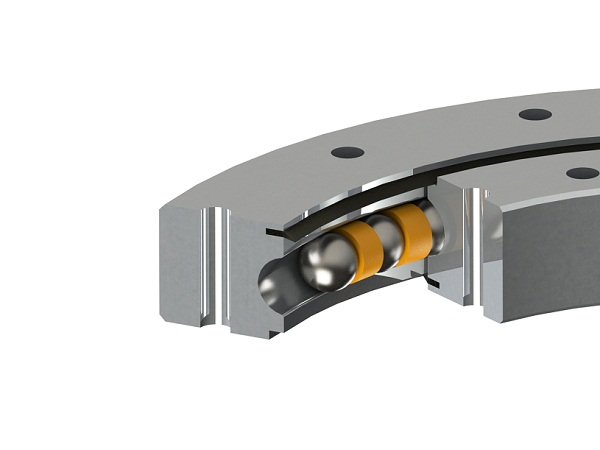
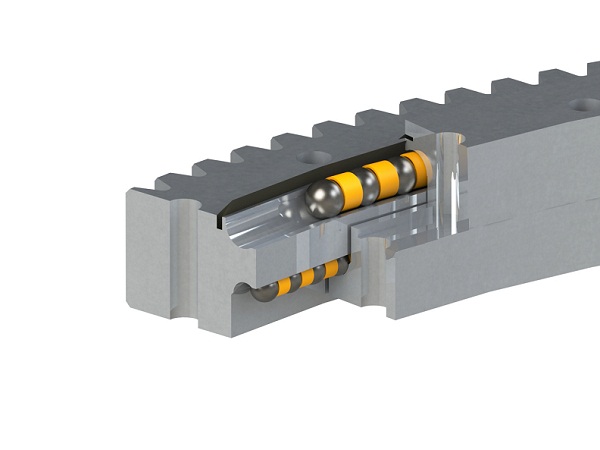
Slewing Bearing Installation Surface

Mechanical machining of the bearing connection surfaces on the connecting structure is required . The mounting position of slewing bearings must correspond to that shown in the drawing. If a transporting cross was delivered, it has to be removed before installation.

The corrosion protection can be removed with an alkaline cleaner. Cleaner must be prevented from coming into contact with the seals or the raceway. Remove the protective coating from the upper and the lower mounting surfaces of the slewing bearing as well as from the gear.

The corrosion protection can easily be removed, for example, using a biodegradable alkaline cleaner.

Rapid removal of the corrosion protection and low environmental impact.

The unhardened zone between the beginning and the end of the hardened region of the raceway is marked with an “S” on the inner or outer diameter of each bearing ring. On the gear ring, the hardness gap is marked on the axial surface. Wherever possible, the hardness gap “S” must be positioned outside the main load-carrying areas. If the main working area for the application is known, then the hardness gap of the ring loaded on the circum-ference must also be positioned outside the main load-carrying area.

The bearing must be completely screwed on for commissionings and test runs. Sufficient load / moment loan must be applied to avoid a slip-stick effect on the anti-friction bearing bodies.

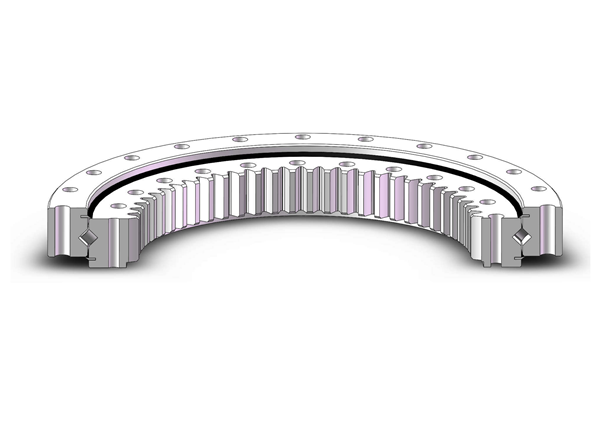
Gearing

Entanglement hazard due to exposed gear

  • Keep hands away from moving parts

The backlash is adjusted relative to the three gear teeth marked in green and should be 0.03 – 0.04 x module.After the final tightening of the bearing,the backlash should be rechecked over the entire circumference. A tip edge radius and a tip relief must be provided on the pinion.

How to maintain the slewing bearing during use?

We know that the quality of the slewing bearing itself is the main factor affecting the service life of the bearing, but no, because in addition to the quality of the bearing, there is also a very important issue, that is, the maintenance and maintenance of the bearing during its use, but, How to maintain the slewing bearing during use?

Lubrication of slewing bearing
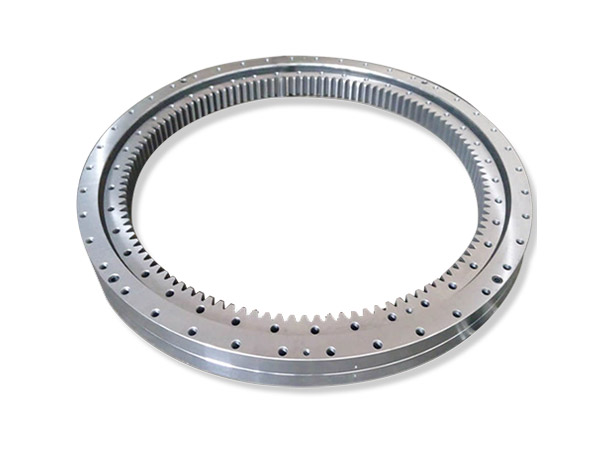
Slewing Bearings

1. Lubrication

(1) Reduce friction and wear. In the mutual contact parts of the rings, rolling elements and cages that constitute the bearing, metal contact is prevented, and friction and wear are reduced.

(2) Extend the fatigue life. The rolling fatigue life of the bearing is extended when the rolling contact surface is well lubricated during rotation. Conversely, if the oil viscosity is low and the lubricating oil film thickness is not good, it will be shortened.

(3) Discharge frictional heat and cooling. The oil circulation method, etc., can use oil to discharge heat generated by friction or heat from the outside, and cool it. Prevent the bearing from overheating and prevent the aging of the lubricating oil itself.

(4) Others. It also has the effect of preventing foreign matter from entering the inside of the bearing, or preventing rust and corrosion.

2. Lubrication method

Bearing lubrication methods are divided into grease lubrication and oil lubrication. In order to make the bearing function well, first of all, it is necessary to select a lubrication method suitable for the conditions of use and the purpose of use. If only lubrication is considered, the lubricity of oil lubrication is dominant. However, grease lubrication has the advantage of simplifying the structure around the bearing. Compare the advantages and disadvantages of grease lubrication and oil lubrication.

Cleaning of slewing bearing

1. Selection of cleaning materials

As the cleaning agent, cleaning agent and kerosene are generally used. In addition, pay attention to sealing the cleaning agent when not in use to avoid the entry of external magazines and contaminating the cleaning agent. In the case of inattentiveness, cleaning the bearing with the contaminated cleaning agent will not only not have a cleaning effect, but will contaminate the bearing and cause the bearing to be polluted. Running brings stress.

2. Cleaning precautions

(1) The disassembled bearing is cleaned, divided into coarse cleaning and fine cleaning, and placed in the container respectively, first put on the bottom of the metal mesh, so that the bearing does not directly contact the dirt of the container.

(2) During rough cleaning, if the bearing is rotated with dirt, it will damage the rolling surface of the bearing, so be careful. In the rough cleaning oil, use a brush to remove grease and adhesions. After it is roughly clean, transfer to the fine cleaning.

(3) Fine cleaning is to carefully clean the bearing while rotating in the cleaning oil.
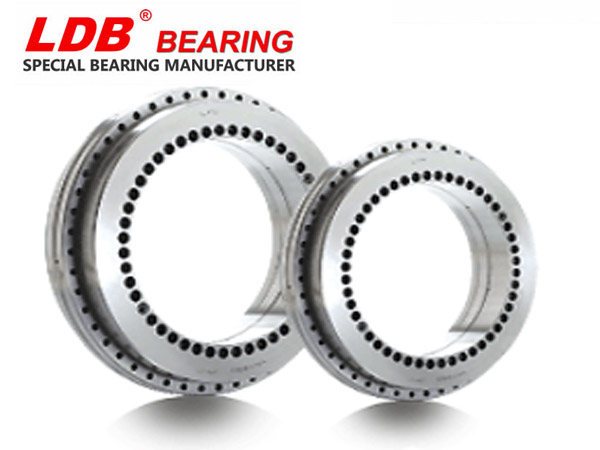
slewing bearings

Maintenance of slewing bearing

1. Maintenance method

(1) Check the state of the raceway surface, rolling surface, and mating surface, the wear of the cage, the increase of bearing clearance, and the damage and abnormality irrelevant to the decrease of dimensional accuracy.

(2) For small ball bearings, support the inner ring horizontally with one hand, and rotate the outer ring to check whether it is smooth. For separable bearings such as tapered roller bearings, the rolling elements and the raceway surface of the outer ring can be inspected separately.

2. Maintenance precautions

(1) In order to judge whether the disassembled bearing can be used, it should be checked after the bearing is cleaned.

(2) Special tools and disassembly steps and techniques should be used for bearing disassembly to avoid damage to the bearing due to the disassembly of the bearing for maintenance, which is not worth the loss.

(3) Since large bearings cannot be rotated by hand, pay attention to checking the appearance of rolling elements, raceway surfaces, cages, rib surfaces, etc. The higher the importance of the bearing, the more careful inspection is required.

The above is the summary of how to maintain and maintain the slewing bearing during the use of the slewing bearing. It can be seen that the maintenance skills in the use of the slewing bearing include lubrication, cleaning, and maintenance.

Bearing lubrication should pay attention to the selection of appropriate lubricants, pay attention to the distinction between coarse and fine washing when cleaning, and pay attention to disassembly, rotation and other issues when overhauling.

Material handling Cranes slewing bearing

Material handling Cranes slewing bearing

Dockside and deck cranes are moving heavier loads, faster than ever before.

Drawing on deep application knowledge and using advanced FEM calculations to optimize designs,LDB slewing bearings for cranes increase reliability and bearing service life, while reducing maintenance costs.

Integrating LDB’s advanced condition monitoring technologies also boost uptime and productivity.

“To solve my technical issue, LDB signiicantly increased the slewing bearing’s service life thanks to advanced calculations and specially developed technical solutions.”- Material handling customer.

Wind Turbine Bearings

Tunnel Boring Slewing Bearing

Scrap standard and service life of tower crane slewing bearing

All machines will experience wear and tear after a long period of use. When the parts exceed the service life or are damaged beyond repair, they should be scrapped and replaced. The tower crane slewing bearing is prone to failure and damage in the long-term outdoor harsh environment and high-load operation, so to what extent does it meet the scrapping standard of the tower crane slewing bearing?

Scrap standard of tower crane slewing bearing

slewing bearing

1. Slewing bearing raceway ring and rolling element wear and scrap

The wear of raceway rings and rolling elements is one of the common forms of scrapped slewing bearings. When there is raceway pitting on the surface of the slewing bearing, surface metal peeling and overall wear, abnormal noise, rolling element jamming and excessive clearance between the raceway rings will occur in the tower crane during operation, resulting in vibration and local impact. With the development of the state, the slewing resistance will continue to increase and the slewing function will be lost.

2. The slewing bearing cage is damaged and scrapped

In order to avoid mutual friction between the rolling elements, the tower crane slewing bearing usually adds a spacer cage between the rolling elements. The material of the cage is generally copper, plastic, powder metallurgy or mild steel. During the working process of the bearing, the cage does not transmit the load, but it moves with the rolling elements. When the cage is damaged or broken, there will be a sharp and ear-piercing abnormal sound. As the broken body of the cage is pushed and rolled by the rotating rolling body, it will cause serious damage to the raceway ring and the rolling body. At this time, the slewing bearing meets the scrap standard and can be replaced.

3. The slewing bearing gear teeth are damaged and scrapped

The gear meshing methods of tower crane slewing bearing include external tooth meshing and internal tooth meshing. When the surface of the gear teeth is excessively worn, cracks and broken teeth occur. The tooth side clearance of the tower crane slewing bearing gear teeth increases, causing the slewing bearing to lose its function immediately when the tooth is broken, and it cannot be repaired. At this time, the scrapping standard of the tower crane slewing bearing is reached.

4. The connecting bolts of the slewing bearing are damaged and scrapped

Although the connecting bolt of the slewing bearing is not the bearing body, the failure of the bolt will also cause the slewing bearing to fail to work. The damage of connecting bolts in tower crane work is also a common phenomenon. When a slewing bearing connecting bolt loosens or breaks, it often brings about a chain reaction of loosening and breaking of other bolts. At this time, the slewing bearing also needs to be replaced.

5. The slewing bearing is scrapped due to corrosion and burn damage

Due to the complex working environment of the tower crane slewing bearing, the situation that the bearing may encounter is also unpredictable. If it is corroded by corrosive substances such as acid and alkali during operation, it will damage the internal components of the bearing and cause the bearing to be scrapped.

Service life of tower crane slewing bearing

Slewing Bearings

Under a certain load, the number of revolutions or hours that a bearing experiences before pitting occurs is called bearing life. The service life of tower crane slewing bearing is affected by rotational speed, radial load, basic rated load, equivalent compliance, speed coefficient, and fatigue life coefficient.

1. Calculation formula of bearing life

L10–When the bearing load is P, the basic rating life (106 revolutions)

C–Basic dynamic load rating N

ε–index

Ball bearing: ε=3

Roller bearing: ε=10/3

P–equivalent dynamic load (N)

The load on the bearing under actual conditions: A, R, converted into the load under the experimental conditions is called the equivalent dynamic load. For the bearing components, this load is variable. During the experimental study, the bearing life is 106 turns to The unit is more convenient (counter), but in actual production, the general life is expressed in hours, so it is necessary to convert L10×106=Lh×60n.

Slewing Bearings

2. Calculation method of tower crane slewing bearing life

(1) Knowing the bearing type, load and shaft speed, calculate Lh;

(2) Knowing the load, speed and life expectancy, calculate C, and select the bearing model.

Usually, the medium repair or overhaul limit of the machine is taken as the design life of the bearing, generally Lh’=5000, and the temperature coefficient ft should be introduced for the bearing working at high temperature

Ct=ftC

t≤120 125 150 200 300

ft 1 0.95 0.90 0.80 0.60

The above is the relevant content about the scrapping standard of the tower crane slewing bearing. The tower crane may affect its service life due to its complex use environment. At the same time, good maintenance and repair can also prolong the service life of the tower crane slewing bearing.

Is the surface roughness of the slewing bearing as small as possible? How to choose?

Is the surface roughness of the slewing bearing as small as possible? Surface roughness refers to the small spacing and the unevenness of small peaks and valleys that the machined surface has. The roughness of the bearing surface may affect the wear resistance, stability, fatigue strength, stability and other properties of the bearing. Generally speaking, the smaller the roughness of the bearing surface, the better, but it should be determined according to the equipment use requirements and process accuracy.

The surface roughness of the slewing bearing is not as small as possible

Slewing Bearings

Is the surface roughness of the slewing bearing as small as possible? It can be analyzed from the following aspects:

1. Physical properties of materials

The surface roughness of the bearing is often represented by Ra. Generally speaking, from the working principle, we hope that the smaller the surface roughness of the slewing bearing, the better. Generally, the higher the bearing tolerance accuracy level, the better the surface quality and the finer the workmanship. However, two surfaces that are too smooth are prone to gluing (exchange between the same or similar materials, which is similar to the “dyeing phenomenon” in our life, but it belongs to the exchange of metal substances here), while the surfaces that are too rough are prone to gluing. Under the action of force, the surface is prone to peeling off (that is, what we often call wear).

2. Processing cost

Theoretically, the smaller the value of the surface roughness of the slewing bearing, the better, the smaller the roughness, the smoother the surface and the more beautiful the appearance. However, the size of the roughness is determined by the machining process and other factors, such as the friction between the tool and the bearing surface, cutting, and high-frequency vibration in the process.

However, the smaller the surface roughness, the higher the processing cost. Whether the use cost of the part matches the consumption speed and the profit of the equipment production output value. These all need to be considered. Some spare parts do not have high requirements on the roughness of the bearing surface. Excessive pursuit of the surface roughness will affect the economy of processing.

Selection principle of surface roughness of slewing bearing

slewing bearing

1. Economic perspective:

From an economic point of view, on the basis of meeting the performance requirements of the slewing bearing, the lower the accuracy, the better. This allows for lower production costs.

2. Use function:

(1) The roughness value of the working surface is smaller than that of the non-working surface.

(2) The roughness value of the friction surface is smaller than that of the non-friction surface.

(3) The roughness value of the clearance fit is smaller than that of the interference fit.

(4) The roughness of the mating surface should be equivalent to its dimensional accuracy requirements. The smaller the size, the smaller the roughness value should be.

(5) The roughness value of the surface subjected to cyclic load and the inner fillet and concave part where stress concentration may occur should be small.

Is the surface roughness of the slewing bearing as small as possible? I believe everyone is clear. The actual selection of bearing accuracy and surface roughness needs to be determined according to actual needs. In the case of ensuring bearing performance, cost control is also very important.

Slewing Bearing Comes In Many Sizes

Slewing bearing comes in many sizes

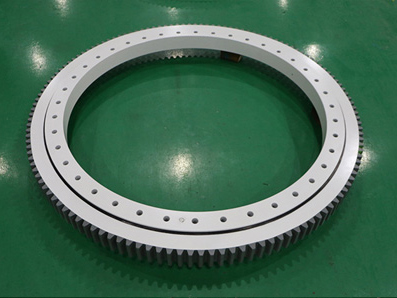
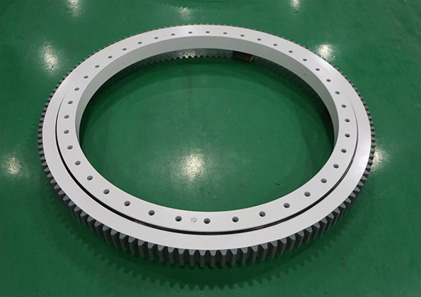
LDB Slewing Bearing Manufacturer custom designed and manufactured a segmented, 3-row roller bearing almost 14 m in diameter. It weighed 70 tons.LDB Slewing Bearing Manufacturer also produces a range of smaller slewing bearings for special machinery,high-tech applications and more.

For more than a half century, LDB Slewing Bearing Manufacturer has been designing and manufacturing many types and sizes of high-performance slewing bearings to meet the speciic needs of customers worldwide. Combining decades of application knowledge and unmatched manufacturing expertise, LDB Slewing Bearing Manufacturer provides customised slewing bearings with outer diameters from 0,1 m to 14 m.

Unlike other providers of slewing bearings, LDB Slewing Bearing Manufacturer can offer fully tailored slewing bearing solutions with integrated advanced monitoring, lubrication and sealing systems for higher reliability and longer service life. Our breadth of engineering knowledge, global presence and design lexibility allow us to deliver the right solution for your project, no matter how large or complex.

High-performance slewing bearings

For a wide range of applications:

  • Wind turbines
  • Tunnel boring machines
  • Excavators
  • Forestry vehicles
  • Rail vehicles
  • Dockside and deck cranes
  • Mobile cranes
  • Water treatment equipment
  • Bottle illing systems
  • Metals
  • Material handling
  • Marine pods
  • Offshore buoys
  • Stacker reclaimers

Model parameters of externally toothed three-row cylindrical roller slewing bearings

Slewing bearing design types:

  • Double row ball bearings
  • 4point

Contact bearings

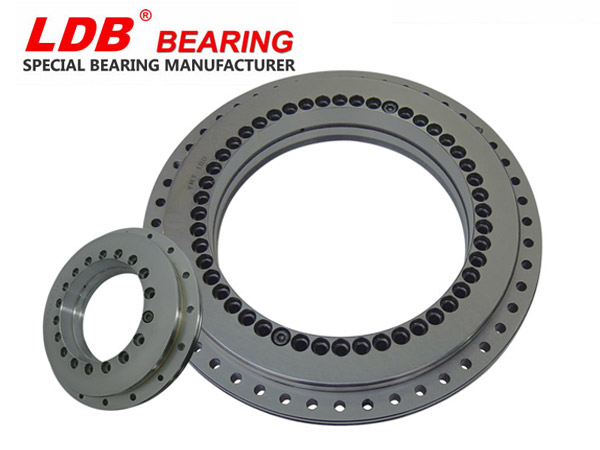
  • Crossed roller bearings
  • Wire race bearings
  • 3row

and double row cylindrical roller bearings

  • Cylindrical roller and ball bearings
  • Special bearings

How is the slewing bearing soft belt produced? The installation position of the flexible belt

The raceway of the slewing bearing generally needs to be heat treated. In the heat treatment process, because the diameter of the raceway circle of the slewing bearing is relatively large, flame surface quenching is usually used. The method is to use acetylene to heat the surface of the workpiece to be hardened and then add water to cool it. , this process is completed continuously.

1. How is the slewing bearing soft belt produced?

During the production and processing of the slewing bearing, the raceway of the device generally needs to be heat treated. The usual processes are: forging → rough machining → quenching and tempering treatment → finishing → raceway surface flame surface quenching → raceway surface grinding and other processes . One of the raceway surfaces is flame quenched to form a soft band.
The so-called soft belt is the area that has not been heat treated. The formation of the soft band is necessary for the heat treatment process. In the heat treatment process of the slewing bearing, because the diameter of the raceway circle of the slewing bearing is relatively large, flame surface quenching is usually used. The method is to use acetylene to heat the surface of the workpiece to be hardened and then add water to cool it.

Slewing Bearings

The heated flame spray gun and water gun are mounted together while making a circular motion along the circle of the workpiece. When the movement is close to 360 degrees, the heating and water spray are stopped immediately. That is, the circular areas of heating and water spray do not overlap. Cracks in the workpiece can occur if the circle areas where the heating and water spray occur overlap (heat treatment at an angle greater than 360 degrees on the circle). The tangential width of the unheated area is typically 15 mm. This 15 mm area is called the soft belt in the slewing bearing, that is, the so-called soft belt is the area without heat treatment. The formation of the soft band is essential to the heat treatment process.
​​
Under normal circumstances, the steel character “S” is marked on the position where the soft belt exists in the workpiece to indicate the specific soft belt position. The installation position of the soft belt is essentially to improve the life of the bearing. From the perspective of the user and the manufacturer, it is still a reasonable position to install the upper and lower ring soft belts of the slewing bearing. Therefore, the manufacturer of the slewing bearing should accurately mark the position of the soft belt of the slewing bearing, and the manufacturer and installer should reasonably install the position of the soft belt of the slewing bearing as needed.

2. The installation position of the soft belt

Slewing Bearings

Usually the upper loop flexible belt of the slewing device is installed at a position perpendicular to the projection line of the pitching rotation plane. For example, the upper loop flexible belt of the slewing device of a ship loader or stacker-reclaimer should be installed at a position perpendicular to the center line of the cantilever and cut through the center of rotation , that is, standing at a 90-degree position facing the left or right side of the cantilever on the center of rotation. In the usual mechanical design, the soft belt does not have the stress state of the support roller of the slewing bearing device at this position.

The installation position of the lower ring soft belt of the slewing device should be determined according to the center of gravity of the equipment and the range of the slewing angle. If the rotation angle is 100 degrees left and right, and the center of gravity of the upper part of the rotation is in the front, it is recommended to install the lower ring soft belt at the rear, that is, at a position of 180 degrees. If the change position of the center of gravity of the upper part of the rotation is the same in the front and rear positions, the angular position of the lower ring soft belt can be installed arbitrarily.
​​
Because of the inevitability of the soft belt on the slewing bearing device, it is required that the user who uses and selects the slewing bearing device should install the position of the soft belt reasonably, so as to improve the service life of the bearing. The general principle is to try to install the soft belt in a position where the soft belt is under less pressure during the load change.

What are the sealing methods of the slewing bearing? Sealing function and method

We know that the slewing bearing has a very important role in some production, and in order to ensure these functions, we need to perform a lot of operations on the slewing bearing during the use of the slewing bearing. The sealing of the more common bearings, then why should the slewing bearing be used? to seal? What are the common sealing methods of slewing bearings?

The role of sealed slewing bearing

Slewing Bearings

1. Isolate foreign objects from outside

Protect the bearing to prevent external dust, dirt, metal particles, moisture, acid gas and other debris from invading the inside of the bearing. If the bearing is poorly sealed and external debris invades, the working condition of the bearing will be significantly deteriorated, and the service life of the bearing will be significantly reduced.

2. Prevent grease leakage

If the oil leaks, it will quickly destroy the normal lubrication of the bearing, causing the bearing to burn out due to heat. In addition, the poor sealing device not only causes waste of oil leakage, but also contaminates mechanical equipment and processed products. Therefore, to make the machine work properly, the bearing must have a good sealing device.

The way of sealing the slewing bearing

Slewing Bearings

Generally, the sealing methods of bearings include contact sealing and non-contact sealing, but these two sealing methods are suitable for different situations. Contact sealing is suitable for bearings operating in medium and low-speed working environments, while non-contact sealing Bearings that are suitable for high-speed and high-temperature working environments, as slewing bearings, generally operate at low speeds, but there are also high-temperature operations. The analysis shows that the methods of sealing slewing bearings are as follows:

1. Felt ring seal

A trapezoidal groove is opened on the bearing cover, and the fine felt on the rectangular surface is placed in the trapezoidal groove to contact the shaft, or the gland is pressed axially, so that the felt ring is compressed to generate radial pressure and hug the shaft, thereby achieve the purpose of sealing. The sealing structure is simple and the cost is low, but the sealing effect is poor, it cannot be adjusted, and the wear is serious.

2. The leather bowl is sealed

Place a sealing cup in the bearing cover (the cup is made of rubber and other materials) and press it directly on the shaft. In order to enhance the sealing effect, a ring-shaped coil spring is used to press the inner ring of the leather cup, so that the inner ring of the leather cup and the shaft have a tighter fit, and the sealing effect is better than that of the felt ring. /s of grease lubrication or lubricating oil lubrication.

3. Sealing ring seal

The sealing ring is usually made of leather, plastic or oil-resistant rubber, and can be made into different cross-sectional forms as required. The 0-shaped sealing ring has a circular section and is pressed on the shaft by its own elastic force. It has a simple structure and is easy to assemble and disassemble. Also commonly used are J-shaped and U-shaped profile seals, which all have a lip-shaped structure. The direction of the sealing lip is towards the sealing part, which is similar to the direction of the flange in the cup seal. When the temperature is high and the rotational speed is high, it is recommended that the sealing lip also be installed away from the bearing. The sealing effect of the sealing ring is better than that of the felt ring, and it can be used for the sealing of grease and oil.

news2

4. Skeleton seal

The skeleton seal we often say is the improvement of the leather cup seal. In order to improve the overall strength of the leather cup seal, a metal lining with an L-shaped cross-section and an overall annular shape is installed in the oil-resistant rubber, so that the leather cup seal is not easily deformed and improves the use of This kind of seal is easy to install and has good performance. It is generally suitable for occasions where the peripheral speed of the journal is 7m/s.

5. Sealing ring seal

This is an annular seal with a gap, which is placed in the ring groove of the sleeve, the sleeve rotates with the shaft, and the seal ring is pressed against the static part by the elasticity of the gap after being compressed. On the inner hole wall, it can play a sealing role, and this kind of sealing is more complicated.

6. Labyrinth seal

The basic principle of this kind of seal is to form a section of flow channel with great flow resistance at the seal. Structurally, a small tortuous gap is formed between the stationary part and the rotating part, forming a “labyrinth”. If the “labyrinth” is radial, the axial dimension is compact, but the radial dimension is larger. If the “labyrinth” is axial, the radial dimension is compact, but the bearing cover should be divided, and the axial clearance should be larger, so as not to be stuck due to thermal deformation of the shaft. Labyrinth seals are quite reliable for both lubricating oil and bone grease, and the higher the speed, the better the effect.

The above is the summary of the sealing methods of the slewing bearing, and the whole content of the sealing function and method. We have learned that the slewing bearing has the functions of isolating foreign objects and preventing grease leakage. The common methods are felt ring sealing, leather cup Seal, seal ring seal, skeleton seal, seal ring seal, labyrinth seal, etc., you can choose according to the specific situation of your bearing

What are the classifications of slewing bearings? How to choose a model?

There are many classifications of slewing bearings, each type has different characteristics, and the scenarios used are also different. You may not be very clear about the selection type. Generally, the selection type should be considered: slewing accuracy, bearing capacity, working temperature, In terms of running speed, etc., let’s take a look at the specific method with the slewing bearing manufacturer~

Classification of slewing bearings

Four Point Contact Ball Slewing Bearing

1. Three-row combined roller slewing bearing

The three-row roller slewing bearing has the upper and lower and radial raceways of the three races separated, so that the load of each row of rollers can be accurately determined. It can bear various loads at the same time, has a firm structure, and has large shaft and radial dimensions. It is suitable for heavy machinery requiring large diameters.

2. Double row angular contact ball slewing bearing

The double-row ball slewing bearing has three races, and the steel balls and spacers can be directly discharged into the upper and lower raceways. According to the stress conditions, two rows of steel balls with different diameters are arranged. The axial and radial dimensions of the double-row ball slewing bearing are relatively large, and the structure is firm, especially suitable for machinery that requires a medium or larger diameter.

3. Single row cross roller slewing bearing

The single-row cross-roller slewing bearing is composed of two races, with compact structure, high manufacturing precision, light weight, small assembly clearance, and can bear axial force, large radial force and tipping moment at the same time.

4. Single row four-point contact ball slewing bearing

The single-row four-point contact ball bearing slewing bearing is composed of two races, with compact structure, light weight, four-point contact between the steel ball and the arc raceway, and can bear axial force, radial force and tipping moment at the same time.

Factors to consider when choosing a slewing ring bearing type

Double Row Different Diameter Ball Slewing Bearing

1. Carrying capacity

The bearing capacity is one of the factors that determines the size of the bearing. In general, the four-point contact ball slewing bearing can withstand heavier radial loads, so it may be more suitable for the occasions where the heavier load and the size and direction of the load may change The four-point contact is a slewing bearing.

2. Rotation accuracy

If the bearing positioning capability is required to be high, the crossed roller slewing bearing can be selected.

3. Working temperature

In general, the operating temperature of the slewing ring bearing mainly depends on the sealing material, grease, isolation block, and the operating temperature range is -25 to +70 °C.

4. Running speed

The four-point contact ball slewing ring bearing has a high limit speed, and the friction force generated is smaller than that of the cylindrical roller slewing ring.

5. Sealing conditions

Qualified seals used in slewing bearings can provide good moisture and pollution protection, and ensure sufficient quality in the bearing, which can prolong the service life of the bearing, so the seal is very important for the performance of the slewing bearing.

6. Vibration

For vibration applications, both four-point contact ball slewing rings and crossed cylindrical roller slewing rings are suitable.

The above article describes the classification of slewing ring bearings in detail, and the factors that need to be considered when choosing the type. I hope it can help you. If you have other questions about slewing ring bearings, you can leave us a message~

What are the common load forms of slewing bearings?

We all know that no matter what the bearing is, it will bear a certain load, and the slewing bearing is no exception. So, what is the load of the slewing bearing? What are the common load forms of slewing bearings? Today, the editor will introduce to you the common load forms of slewing bearings, hoping to help you understand more about slewing bearings.

1. What is the slewing bearing load?

It is only said that the load refers to the external force and other factors that cause the internal force and deformation of the structure or component, and the load of the bearing refers to the limit force that the bearing can bear under the action of the internal force and external force. The load is also called the load, which is used as a slewing bearing. Said that the types of loads it can bear include traditional radial and bearing loads, working loads, temperature loads, etc. The following editor will introduce these loads to you respectively.

2. Common load forms of slewing bearings

Slewing Bearings

(1) Radial and axial loads

In a rolling bearing, when the total plastic deformation is less than one ten thousandth of the diameter of the rolling element at the contact point between the rolling element and the raceway that bears a relatively large load, it has little effect on the normal operation of the bearing.

The static load capacity of the bearing determined under this plastic deformation condition is called the rated static load. The rated static load is determined under the assumed load conditions. For radial bearings, the rated static load refers to the radial load, and the radial load Thrust bearing (angular contact ball bearing) refers to the radial component of the load that loads the half-ring raceway in the bearing, and for a thrust bearing, it refers to the central axial load. The basic static load rating and basic static load rating of the bearing refer to the maximum load that the bearing can bear when it is static or rotating.

(2) Working load

The working load means that the slewing bearing device bears the weight of the machine itself and the weight of the increased weight during work, and then slowly transfers the total weight to the slewing bearing device. Ensure that the slewing bearing device has a steady stream of power and operates normally.

(3) Temperature load

When the mechanical equipment is working, it will generate a certain temperature, and all these temperatures must be absorbed by the slewing bearing device, so that the slewing bearing can withstand all the temperatures. The force of the slewing bearing against temperature is what we call the temperature load.

(4) Wind load

When the machine works in the open air, it is necessary to consider the effect of wind load, including wind direction, rain, thunderstorm weather and so on. The above is only a part of the load that the slewing bearing device bears. In fact, the slewing bearing device needs to bear more load in order to meet all the weight and load of the machine in work. Under normal circumstances, the slewing bearing itself is equipped with mounting holes, lubricating oil and sealing devices, which can meet the different needs of various types of hosts working under various working conditions.

slewing bearings

(5) Risk load

That is, the unexpected and unpredictable loads, cross forces, risk forces, unexpected violence, etc. that the slewing bearings and slewing bearings bear. Therefore, the selection of the slewing bearing will have the existence of a safety factor to ensure foolproof.

(6) Dynamic load

Dynamic loads include inertial loads, vibration loads and shock loads. The mass force caused by the change in the magnitude and direction of the movement speed becomes the inertial force. These are all part of the dynamic load.

(7) Static load

The load capacity of the bearing at rest is determined by the allowable amount of plastic deformation. Plastic deformation in rolling bearings is unavoidable. If the allowable amount of plastic deformation is limited, the static load capacity of the bearing is also small; if the allowable plastic deformation is large, the pits generated on the raceway will increase the noise and vibration of the bearing during operation, and improve the running accuracy. Reduced, affecting the normal operation of the bearing.

The above is what the common load forms of slewing bearings are summarized by Xiaobian for you, and all the types of loads that slewing bearings can withstand. We understand that the common load types of slewing bearings include traditional radial load and axial load, working load , temperature load, wind load, risk load, dynamic load, static load, etc. Because of the existence of these loads, the slewing bearing can operate safely and ensure the normal operation of the equipment.