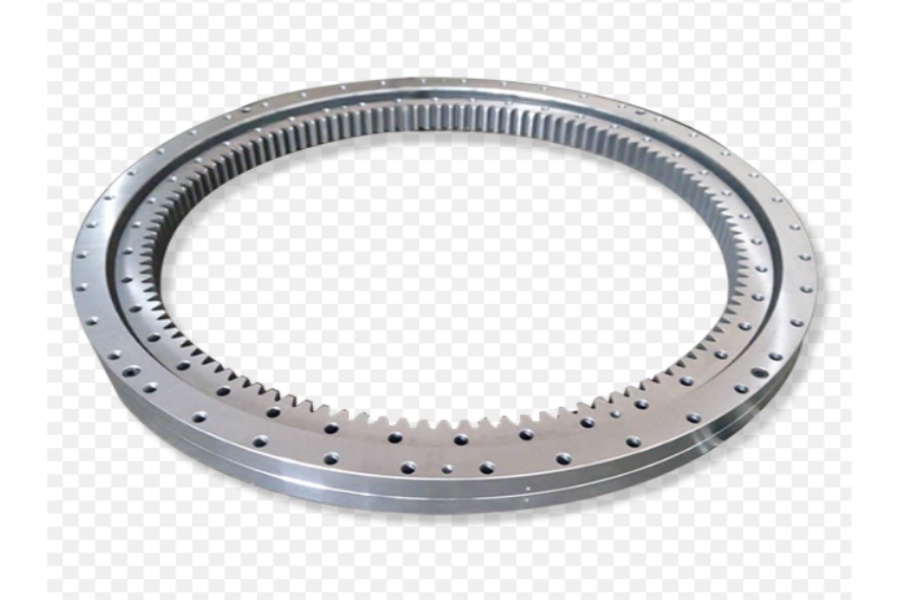
Low-Temperature Slewing Bearing Selection: Material Toughness and Seal Performance in Arctic Conditions
When heavy machinery—such as mining excavators, port cranes, and wind turbines—operates in sub-zero environments like arctic regions or high-altitude plateaus, standard mechanical components face severe performance degradation. Among all critical components, the slewing bearing bears the brunt of combined axial, radial, and overturning moment loads under extreme thermal stress.
Choosing a slewing bearing for sub-zero conditions requires going beyond standard load-rating calculations. Engineers must meticulously evaluate material metallurgy, impact toughness, and elastomeric seal resilience.
The Low-Temperature Challenge: Material Brittleness and Charpy V-Notch Requirements
At low temperatures, carbon and alloy steels undergo a transition from ductile behavior to brittle behavior.
- The Ductile-to-Brittle Transition Temperature (DBTT): If the operating temperature drops below the DBTT of the bearing ring material (such as conventional 50Mn or 42CrMo4), the risk of catastrophic, sudden brittle fracture under high impact loads increases exponentially. To understand the foundational metallurgical differences between these options, you can review our guide on choosing the right material and heat treatment for slewing bearings.
- Impact Toughness Specifications: For low-temperature slewing bearings, material selection must be backed by guaranteed Charpy V-Notch (CVN) impact test data. LDB Bearing recommends ensuring that the chosen steel grade maintains high absorbed energy (typically specified at $-20^\circ\text{C}$ or $-40^\circ\text{C}$ depending on the application tier) to absorb dynamic shock loads without crack propagation.
- Through-Hardening vs. Induction Hardening: The raceway induction hardening depth must be tightly controlled to prevent micro-cracking at the transition zone between the hardened case and the soft core under thermal contraction strains. For more insights on optimizing gear teeth and surface treatments, check out our best practices guide on induction hardening and gear tooth failure modes.
Lubrication Breakdown: Selecting Arctic-Grade Greases
Grease viscosity changes dramatically as temperatures plummet, which can lead to severe operational issues:
- High Viscosity Drag: Standard greases thicken or solidify in extreme cold, causing excessive starting torque, motor overload, or complete drive stall.
- Base Oil and Thickener Selection: Arctic-grade slewing bearing greases utilize synthetic base oils (such as PAO or synthetic esters) with low pour points and specialized thickeners (like lithium-complex or synthetic polyurea) that maintain fluidity and pumpability at temperatures as low as $-40^\circ\text{C}$ or even $-50^\circ\text{C}$. For a broader understanding of lubricant formulation, you can read our comprehensive practical guide on base oils, thickeners, and additives.
- Extreme Pressure (EP) and Anti-Wear (AW) Additives: Low-temperature greases must still provide robust film strength to prevent micro-pitting and fretting corrosion during sluggish, low-amplitude oscillating movements common in wind turbine pitch systems.
Seal Integrity: Preventing Contaminant Ingress in Frozen Environments
Rubber and polyurethane seals lose their elasticity in freezing conditions, becoming rigid and prone to cracking, which lets in fine snow, ice crystals, and abrasive dust.
- Material Selection: Standard NBR (Nitrile Rubber) stiffens rapidly in severe cold. For arctic applications, specialized low-temperature elastomers such as HNBR (Hydrogenated Nitrile Butadiene Rubber) or Silicone/Fluorosilicone blends are essential to maintain flexibility and memory retention.
- Multi-Lip Seal Geometries: Designing optimized multi-lip contact seals prevents the accumulation of packed snow and ice freeze-thaw cycles from prying open the sealing gap. Integrating labyrinth metal shields alongside elastomeric lips adds a mechanical defense layer against ice-shearing forces.
Summary Checklist for Engineers
| Design Parameter | Standard Industrial Condition | Extreme Low-Temperature Condition |
| Ring Material | 50Mn / 42CrMo4 (Standard normalized/quenched) | Modified 42CrMo4 with certified low-temp CVN impact toughness |
| Lubrication | Lithium-based EP2 grease (-20°C to +120°C) | Synthetic PAO-based low-temp grease (-40°C to -50°C rating) |
| Sealing Material | Standard NBR | HNBR or specialized cold-resistant elastomers |
| Internal Clearance | Standard manufacturing clearance | Adjusted thermal-fit clearance to compensate for housing/shaft shrinkage |
Engineered for Extremes: Partner with LDB Bearing
At Luoyang LDB Bearing, we understand that heavy machinery operating in arctic or high-altitude environments cannot afford unexpected downtime. Headquartered in Luoyang—China’s renowned bearing manufacturing hub—LDB specializes in engineering and manufacturing high-performance Slewing Bearings, Slew Drives, and spur gear drives tailored to rigorous operating conditions.
- Custom Metallurgy & Heat Treatment: We offer tailored heat treatment protocols and certified low-temperature impact testing (CVN) to ensure structural integrity down to $-40^\circ\text{C}$ and below.
- Rigorous Quality Control: Every slewing bearing undergoes strict dimensional inspection, raceway hardness testing, and clearance verification before dispatch.
- Global Engineering Support: Whether you are designing excavators for Siberian mines or wind turbines for alpine ridges, our engineering team works directly with your specifications to deliver reliable, custom-engineered rotational solutions.
Ready to upgrade your machinery’s performance in sub-zero environments?
- Contact Our Engineering Team Today to discuss your project requirements.
- Request a Custom Quote & Technical Drawing and let LDB Bearing provide a tailored solution for your extreme operating conditions.
Frequently Asked Questions (FAQ)
Q1: What is the lowest operating temperature standard slewing bearings can withstand?
Standard industrial slewing bearings utilizing regular 50Mn or 42CrMo4 materials and standard NBR seals are generally rated down to $-20^\circ\text{C}$. Operating below this threshold without material modification or specialized lubrication risks brittle fracture and seal failure.
Q2: Can LDB Bearing customize slewing bearings for sub-zero arctic conditions?
Yes. LDB Bearing regularly provides fully customized solutions for extreme environments, including specialized alloy steel sourcing, certified low-temperature impact toughness testing, low-temperature synthetic greases, and HNBR cold-resistant multi-lip seals.
Q3: How does thermal contraction affect internal clearance in low-temperature bearings?
As temperatures drop, both the bearing rings and the mounting structure undergo thermal contraction. This can significantly reduce the internal clearance of the bearing, leading to pre-loading, increased friction, and accelerated wear. LDB engineers calculate and adjust the initial manufacturing clearance to compensate for expected thermal shrinkage during the design phase.